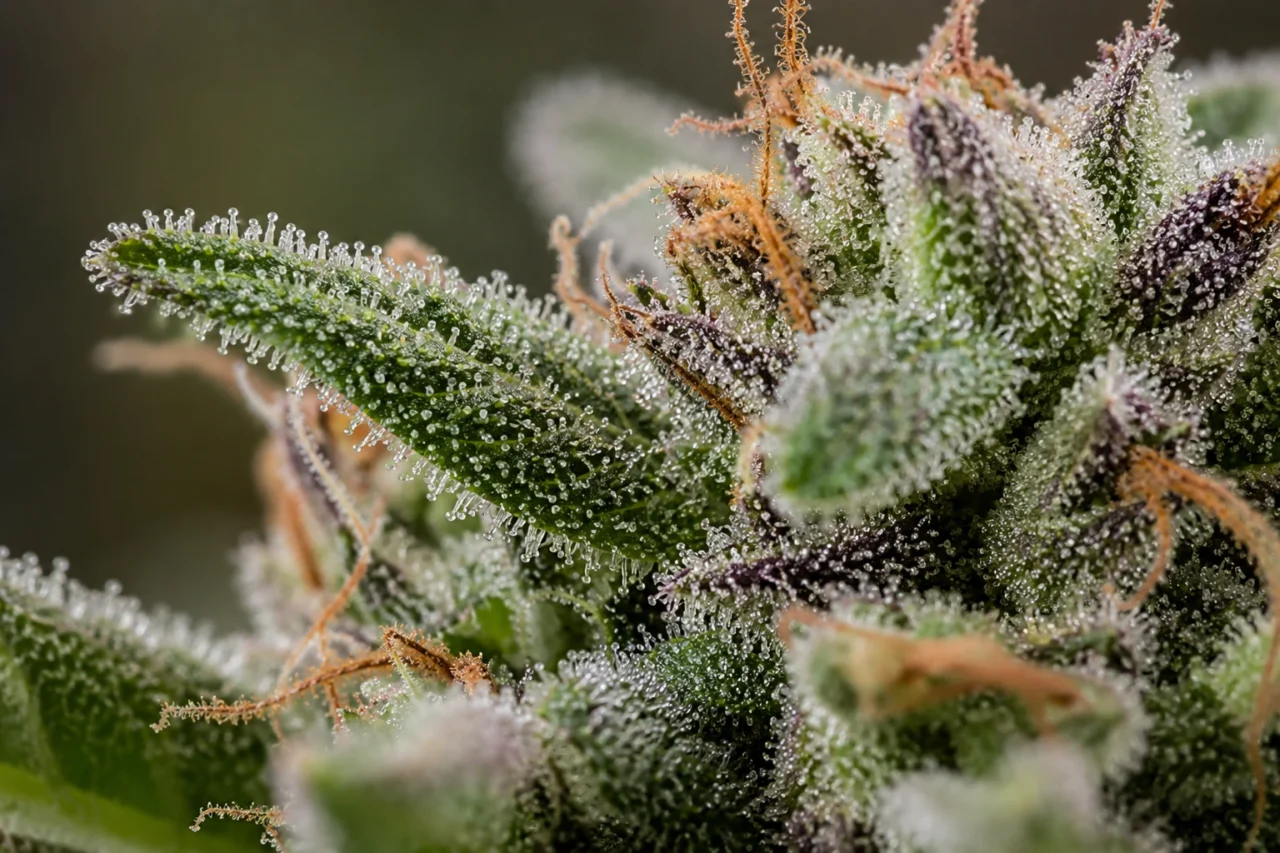
If you have ever noticed tiny, sparkling crystals covering a cannabis flower, you have already seen cannabis trichomes. They are responsible for much of the sticky, frosty appearance of cannabis buds and play a major role in the plant’s chemistry.
But what exactly are cannabis trichomes? Are they related to THC? Do clear, cloudy, and amber trichomes mean different things? And can you really tell when cannabis is ready to harvest just by looking at them?
The short answer is that cannabis trichomes are specialized structures on the plant’s surface that produce and store cannabinoids, terpenes, and other compounds. They are especially concentrated on female flowers, where stalked glandular trichomes serve as important sites for cannabinoid and terpene production.
This guide explains the science behind cannabis trichomes, the main types you may encounter, what their changing appearance can tell you, and why trichome appearance should not be confused with a laboratory potency test.
What Are Cannabis Trichomes?
Cannabis trichomes are tiny structures that grow from the surface of the cannabis plant. The word “trichome” comes from a term meaning hair, although cannabis trichomes can look more like tiny mushroom-shaped glands than ordinary plant hairs.
They are found on several parts of the plant, including flowers and leaves, but glandular trichomes are especially abundant on female flowering structures. These glands produce and store resin containing cannabinoids and terpenes.
Under magnification, a mature glandular trichome can look like a small stalk topped with a rounded head. The head contains secretory cells and a storage area where plant compounds accumulate.
Those compounds include:
- Cannabinoids such as THCA, CBDA, and CBGA
- Terpenes that contribute to aroma and flavor
- Other specialized plant metabolites
This is why cannabis trichomes are so closely associated with the smell, resin, and chemical profile of cannabis flower.
Why does cannabis produce trichomes?
Trichomes are useful to the plant itself. Across many plant species, trichomes can provide physical and chemical protection against insects, environmental stress, heat, and intense light.
In cannabis, resin-producing trichomes appear to have several protective functions while also serving as the plant’s primary production and storage sites for valuable secondary metabolites.
So, the frosty appearance of a cannabis bud is not simply decoration. It is part of the plant’s natural biology.
Why Are Cannabis Trichomes Important?
The importance of cannabis trichomes comes down largely to what happens inside them.
Many of the cannabinoids people associate with cannabis are synthesized in glandular trichomes. Stalked glandular trichomes on female flowers are particularly important for producing and accumulating these compounds.
Terpenes are also closely associated with these glands. They contribute significantly to the distinctive aromas and flavors found in different cannabis varieties.
This means cannabis trichomes are connected to several characteristics people commonly evaluate when looking at flower:
- Resin production
- Aroma
- Flavor
- Cannabinoid content
- Terpene content
- Flower maturity
However, there is an important distinction: seeing a large number of trichomes does not tell you the exact THC or CBD percentage of a product.
Laboratory testing remains the better way to determine cannabinoid and terpene concentrations.
The Three Main Types of Cannabis Trichomes
Researchers commonly describe three glandular forms of cannabis trichomes:
- Bulbous trichomes
- Capitate-sessile trichomes
- Capitate-stalked trichomes
They differ in their structure, size, location, and contribution to resin production.
1. Bulbous Trichomes
Bulbous trichomes are among the smallest trichomes found on cannabis.
Because they are extremely small, they generally cannot be examined properly with the naked eye. They can occur across different parts of the plant and have a relatively simple structure.
Their contribution to cannabinoid production is comparatively limited when compared with larger glandular trichomes.
2. Capitate-Sessile Trichomes
Capitate-sessile trichomes have a more developed glandular structure than bulbous trichomes.
They have a rounded gland head with little or no obvious stalk and can be found on leaves and flowering areas. Research has shown that these trichomes contain secretory cells capable of producing specialized metabolites.
Although they contribute to the plant’s chemical profile, they are generally not considered the primary source of cannabinoid production in mature cannabis flowers.
3. Capitate-Stalked Trichomes
Capitate-stalked trichomes are the structures most people picture when they think about cannabis trichomes.
They have a stalk supporting a relatively large glandular head. These trichomes are especially prominent on female flowers and are major sites for cannabinoid and terpene production.
Inside the gland head, secretory cells produce compounds that accumulate in a resin-filled cavity. This is one reason mature cannabis flowers can appear sticky and heavily coated with resin.
Among the three traditional glandular categories, stalked trichomes are particularly important from a chemical and commercial perspective.
Where Are Cannabis Trichomes Found?
Cannabis trichomes are not found exclusively on the buds.
Different trichome types can occur across the plant, including:
- Female flowers
- Bracts
- Calyxes
- Sugar leaves
- Other leaves
- Stems and other aerial structures
The distribution is not uniform. Female flowering structures generally contain a much higher concentration of glandular trichomes than many other parts of the plant.
This concentration is one reason cannabis flowers can look dramatically more “frosty” than large fan leaves.
What Do Cannabis Trichomes Look Like?
At normal viewing distance, cannabis trichomes can make a flower look covered in sugar or tiny crystals.
With a magnifying loupe or digital microscope, individual trichome heads become easier to see.
Depending on their stage of development, the heads may appear:
- Clear or transparent
- Cloudy or milky
- Amber or brownish
These color changes can provide clues about flower development. Scientific studies have documented a progression in trichome-head appearance as cannabis flowers mature.
However, color should be treated as an observation rather than an exact chemical measurement.
What Do Clear Cannabis Trichomes Mean?
Clear cannabis trichomes have transparent-looking gland heads.
They are commonly associated with an earlier stage of flower development. As the flower matures, the contents of the glandular head can become increasingly opaque.
Growers may monitor this change as one part of deciding when a plant has reached a desired stage of maturity.
It is worth avoiding a common oversimplification, though: clear trichomes do not provide a precise THC reading.
A plant’s cannabinoid profile depends on genetics, development, cultivation conditions, and other factors.
What Do Cloudy or Milky Trichomes Mean?
Cloudy cannabis trichomes have a whitish or opaque appearance instead of looking completely transparent.
This appearance is associated with advancing flower maturity. Researchers have documented changes in glandular trichome structure and contents as flowers develop, including changes from clear-looking material toward a cloudy appearance and eventually darker coloration.
Many growers use cloudy trichomes as a visual maturity indicator.
However, claims that a specific percentage of cloudy trichomes always equals “maximum THC” are too simplistic. Different plants mature differently, and visual appearance does not replace laboratory analysis.
What Do Amber Cannabis Trichomes Mean?
Amber cannabis trichomes have gland heads that appear yellow, orange, brown, or amber rather than clear or milky.
Research has linked later trichome maturation with changes in the contents of the gland head and, in some studies, structural changes such as shrinkage or eventual detachment of mature gland heads.
Amber coloration can therefore be useful when assessing the development of a flowering plant.
But one popular claim deserves clarification: amber trichomes do not automatically mean that THC has simply “turned into CBN.”
Cannabinoid degradation is influenced by multiple factors, including time, light, temperature, oxygen, and storage conditions. Trichome color alone cannot tell you exactly how much THC or CBN is present.
Do Cannabis Trichomes Determine THC Potency?
Cannabis trichomes are closely connected to cannabinoid production, but their appearance does not provide a precise potency measurement.
Stalked glandular trichomes are major sites of cannabinoid biosynthesis and storage, which explains why trichome-rich flowers can contain substantial cannabinoid concentrations.
Still, several variables affect the final chemical profile:
- Cannabis genetics
- Plant development
- Growing environment
- Flower structure
- Trichome density
- Trichome maturity
- Harvest timing
- Drying and storage
- Post-harvest handling
Two flowers can look similarly frosty while having different laboratory cannabinoid results.
For consumers, a certificate of analysis from an appropriate laboratory is therefore much more useful for determining cannabinoid content than simply counting visible trichomes.
Do More Cannabis Trichomes Mean Better Quality?
Not necessarily.
A dense layer of cannabis trichomes can be visually appealing and may indicate substantial resin production, but “more frost” should not be treated as a universal definition of quality.
Quality depends on several characteristics working together.
When evaluating flower, consider:
1. Resin coverage
Heavy visible resin can indicate abundant glandular trichomes. It is useful as a visual characteristic but does not establish an exact THC percentage.
2. Aroma
The smell of cannabis comes largely from volatile compounds such as terpenes. Because many terpenes are produced or stored in glandular trichomes, aroma can provide information about a flower’s chemical character.
3. Flower condition
Look for flower that has been handled and stored appropriately. Excessive dryness, deterioration, or damaged resin glands can affect the overall product experience.
4. Laboratory information
If cannabinoid potency or terpene content matters, laboratory results are more dependable than visual inspection.
Cannabis Trichomes and Terpenes
One of the most interesting things about cannabis trichomes is their connection to terpenes.
Terpenes are aromatic compounds found throughout nature. In cannabis, they contribute to the characteristic scents and flavors associated with different varieties.
Examples include:
- Limonene: commonly associated with citrus-like aromas
- Myrcene: often described as earthy or herbal
- Pinene: associated with pine-like notes
- Beta-caryophyllene: commonly associated with peppery or spicy aromas
Cannabis can contain a complex mixture of terpenes, and the profile can vary substantially between varieties.
This is another reason why the visual appearance of cannabis trichomes tells only part of the story. Two flowers with similar trichome coverage may smell and taste quite different because their terpene profiles differ.
How to Examine Cannabis Trichomes
You do not need laboratory equipment to get a closer look at cannabis trichomes.
A basic jeweler’s loupe or digital microscope can make individual gland heads easier to see.
When examining them, look for:
- Overall coverage: Are the flowers visibly coated with resin?
- Gland-head appearance: Do they look mostly clear, cloudy, or darker?
- Distribution: Is resin spread throughout the flower or concentrated in certain areas?
- Condition: Do the glands appear intact, or does the flower show signs of excessive handling?
- Consistency: Do different parts of the flower show similar development?
If you are assessing a plant for harvest, checking several areas can provide a better picture than examining one small section.
Can You See Cannabis Trichomes Without Magnification?
Yes, but there is a difference between seeing them and examining them.
The overall coating of cannabis trichomes is often visible on well-developed flowers. That is what creates the familiar sparkling or frosted appearance.
However, identifying individual gland heads and assessing their apparent color is much easier with magnification.
A loupe or digital microscope can help growers observe changes that are difficult to distinguish with the naked eye.
Cannabis Trichomes and Harvest Timing
For growers, cannabis trichomes can be one useful visual tool for monitoring flower maturity.
As flowers develop, trichome heads can change in appearance, and scientific research has documented relationships between trichome development, flower maturation, and cannabinoid accumulation.
Still, there is no universal rule that one trichome color or one fixed percentage is perfect for every cannabis plant.
Genetics and cultivation conditions can influence development, while different cannabinoid-dominant varieties may have different maturation patterns.
For that reason, trichome observation is best considered alongside the broader development of the plant rather than as an isolated harvest formula.
Are Cannabis Trichomes the Same as Kief?
No.
Cannabis trichomes are structures that remain attached to the plant. Kief is loose material made up largely of detached trichomes and their resin.
The distinction is simple:
- Trichomes: microscopic plant structures that produce and store resin.
- Kief: collected resin-rich material that has separated from cannabis flower.
Because kief contains a concentrated amount of detached resin-bearing material, it can look like a fine powder rather than individual mushroom-shaped structures.
What Happens to Cannabis Trichomes After Harvest?
Harvesting does not mean the chemistry of cannabis trichomes stops changing.
Drying, storage, heat, light, oxygen, and time can influence cannabinoids and other compounds. Research has also observed that mature gland heads can become more fragile and may detach during post-harvest handling.
This matters because the way cannabis is handled after harvest can affect the final product.
For consumers, appropriate packaging and storage can help protect the flower from unnecessary exposure to damaging environmental conditions.
Common Myths About Cannabis Trichomes
There are plenty of claims online about cannabis trichomes, but not all of them are supported by strong evidence.
Myth 1: More trichomes always mean higher THC
Not necessarily. Trichomes are important sites of cannabinoid production and storage, but visible density does not provide an exact potency measurement.
Myth 2: All amber trichomes mean strong CBN effects
This is an oversimplification. Amber coloration is associated with later maturation, but trichome color cannot tell you the exact CBN concentration or predict a specific effect.
Myth 3: Cloudy trichomes guarantee maximum THC
Cloudiness can be a useful maturity clue, but it is not a laboratory test. Cannabinoid concentrations vary between plants and can be affected by genetics and growing conditions.
Myth 4: Trichomes are only found on cannabis flowers
They are not. Different forms occur on several aerial parts of the cannabis plant, although glandular trichomes are particularly concentrated around female flowering structures.
Frequently Asked Questions
What are cannabis trichomes used for?
Cannabis trichomes produce and store specialized compounds, including cannabinoids and terpenes. They also appear to serve protective functions for the plant by helping it respond to environmental and biological stress.
Which type of cannabis trichomes produces the most cannabinoids?
Capitate-stalked glandular trichomes on female flowers are major sites of cannabinoid production and storage and generally contribute more to cannabinoid accumulation than bulbous trichomes.
What color should cannabis trichomes be at harvest?
There is no single color that is universally correct for every plant. Clear, cloudy, and amber appearances can indicate different stages of development, but harvest decisions should consider the plant’s genetics and overall maturity rather than one visual rule.
Are cloudy cannabis trichomes stronger than clear ones?
Cloudy trichomes generally indicate a later stage of development than clear trichomes, but color alone cannot establish potency. Laboratory testing is needed to accurately measure cannabinoids.
Do amber cannabis trichomes mean the THC has turned into CBN?
Not automatically. Amber coloration is associated with later trichome maturation, but the relationship between visible color and individual cannabinoid concentrations is more complicated than a simple THC-to-CBN conversion.
Can I see cannabis trichomes with my eyes?
You can usually see the overall frosty coating on cannabis flowers without magnification. A loupe or microscope is much better for examining individual gland heads.
Do cannabis trichomes make cannabis smell?
They play an important role. Glandular trichomes are closely associated with the production and storage of terpenes, which contribute significantly to cannabis aroma.
Are cannabis trichomes important for medical cannabis?
They are important from a plant-science perspective because they are major sites of cannabinoid and terpene production. However, the presence or appearance of trichomes does not by itself determine whether a particular cannabis product is appropriate for a medical condition.
Patients should discuss cannabis products, dosing, interactions, and potential risks with a qualified healthcare professional.
Final Takeaway
Cannabis trichomes are tiny but highly important parts of the cannabis plant. They give flowers their familiar frosty appearance while serving as major sites for producing and storing cannabinoids and terpenes.
The three commonly described glandular types—bulbous, capitate-sessile, and capitate-stalked—are structurally different, with capitate-stalked trichomes playing a particularly significant role in the chemistry of mature female flowers.
The changing appearance of cannabis trichomes can also provide useful clues about flower development. Clear, cloudy, and amber heads are commonly used as visual indicators of maturation, but they should not be treated as exact measurements of THC, CBD, CBN, or expected effects.
If you are evaluating cannabis as a consumer, look beyond appearance. Consider laboratory results, cannabinoid and terpene information, product quality, storage, and your individual needs. Cannabis trichomes can tell you something interesting about the plant, but they are only one part of the bigger picture.
Sources
- Tanney, C. A. S., Backer, R., Geitmann, A., & Smith, D. L. (2021).
Read the full research article - National Library of Medicine — PubMed.
View the PubMed record - National Library of Medicine — PMC.
Read the full-text article - Nolan, M., et al. (2025).
View the PubMed research record - Livingston, S. J., et al. (2023).
Read the full research article - PubMed — Cannabis Trichome Research.
View the PubMed record - The Cannabis Terpenes — National Library of Medicine.
Read the research review