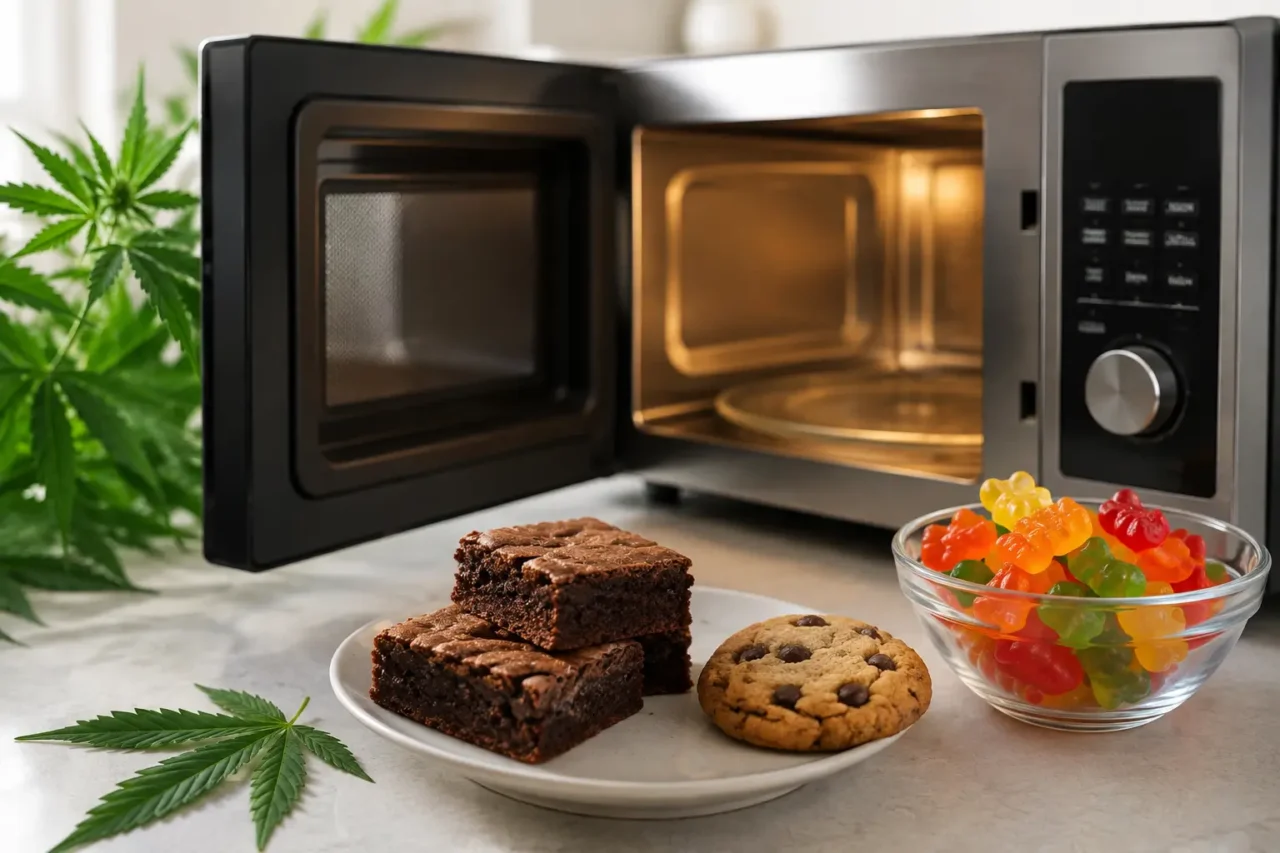
If you have a cannabis gummy, brownie, or chocolate edible and want to warm it up quickly, you may wonder: Can you microwave edibles?
Technically, a microwave can heat cannabis-infused food. The bigger question is whether doing so is a good idea.
The answer depends on the edible, how it is formulated, how much heat it receives, and how evenly that heat is distributed. Cannabis compounds can change when exposed to heat, and research shows that higher temperatures can accelerate cannabinoid degradation. However, there is no single temperature that tells you exactly when every cannabis edible will suddenly “lose its THC.” The food itself, moisture, heating time, and cannabinoid formulation all matter.
So if you are considering microwaving an edible, heating it aggressively is not a reliable way to make it work faster or stronger.
Considering medical marijuana?
Talk with a licensed medical marijuana doctor to understand your options and find out if you qualify.
>>Talk to a Doctor<<
Can You Microwave Edibles?
Yes, cannabis edibles can physically be placed in a microwave, but that does not mean microwaving them is the best way to heat them.
A microwave heats food differently from an oven or conventional water bath. Heating can be uneven, creating warmer areas inside the food. With cannabis products, that matters because cannabinoids are sensitive to temperature and processing conditions.
Research examining THC and other cannabinoids has found that degradation becomes more pronounced as temperature increases. One study examining cannabis resin found that changes in THC and the formation of CBN increased at higher temperatures, particularly under certain acidic conditions.
For that reason, microwaving a cannabis edible can potentially change its cannabinoid content or affect its texture without giving you a predictable benefit.
What Happens to THC When You Heat an Edible?
THC is not completely unaffected by heat.
Cannabinoids undergo chemical changes when exposed to temperature over time. Scientists have studied this process in cannabis flower, resin, extracts, and other cannabinoid-containing materials.
For example, research has demonstrated temperature-dependent degradation of Δ9-THC and the formation of other cannabinoids, including CBN, under certain experimental conditions.
But there is an important detail that is often missed online:
There is no universal “THC destruction temperature” that applies to every edible.
You may see websites claim that THC simply begins disappearing once a particular temperature is reached. In reality, cannabinoid stability depends on several variables, including:
- Temperature
- How long the product is heated
- Moisture content
- The food or oil matrix
- Oxygen exposure
- Acidity
- The specific cannabinoid formulation
A laboratory experiment involving cannabis resin is not necessarily equivalent to heating a commercially manufactured gummy in a kitchen.
That is why it is better to think about heat exposure over time rather than one magic temperature number.
Does Microwaving an Edible Make It Hit Faster?
There is no good evidence that microwaving a cannabis edible makes the THC work faster simply because the edible has been heated.
When you consume an edible, cannabinoids must pass through the digestive system. THC is then metabolized by the liver, producing metabolites such as 11-hydroxy-THC. This is one reason edible cannabis can feel different from inhaled cannabis.
Changing a gummy from a solid into a warm liquid does not remove the normal biological processes involved in oral cannabis consumption.
In other words:
Heating the edible does not automatically turn it into a faster-acting cannabis product.
If someone feels an edible more quickly after dissolving it in a drink, several factors could be involved, including whether they had eaten recently, the product’s formulation, individual metabolism, and expectations about when the effects should begin.
Why Did Microwaving Cannabis Gummies Become Popular?
The idea gained attention through social media videos showing cannabis gummies being dissolved into hot water, tea, coffee, or other drinks.
The appeal is easy to understand. A person may want to transform a gummy into something resembling a cannabis beverage without buying a separate infused drink.
However, viral videos are not the same thing as controlled research.
A social media demonstration may show that a gummy melts. It does not tell you:
- How much THC remains afterward
- Whether the cannabinoids were distributed evenly
- Whether the product’s texture or formulation changed
- Whether the resulting dose is consistent
- Whether the heating method is appropriate for that particular product
Those are much more important questions if your goal is predictable dosing.
Why Microwaves Can Be Tricky for Cannabis Edibles
One reason to be cautious is that microwaves do not necessarily heat every part of a food at exactly the same rate.
You might have a gummy that feels only warm on one side while another portion becomes significantly hotter. The same issue can occur with brownies, cookies, chocolate, and other dense foods.
That creates two separate concerns.
1. Uneven heating
The temperature you feel on the outside may not represent the temperature in the center of the edible.
2. Changes to the food itself
Heat can alter sugar, gelatin, chocolate, fats, moisture, and other ingredients. Even if the cannabinoids remain relatively stable, the edible may no longer have the same texture or consistency.
For a commercially manufactured edible, changing the product can also make it harder to know whether the labeled serving size still corresponds to the way you are consuming it.
Do Different Types of Edibles React Differently to Heat?
Yes.
A gummy, chocolate bar, brownie, and infused beverage are very different products. Their ingredients and physical structures influence how heat moves through them.
1. Cannabis gummies
Gummies contain ingredients such as gelatin or pectin, sugars, water, flavorings, and cannabis extracts. Heating can change their texture and consistency.
If a gummy is overheated, it may become sticky, separate, harden after cooling, or otherwise change from its original form.
2. Cannabis chocolate
Chocolate melts relatively easily compared with many other edible formats. However, overheating can still affect its texture, flavor, and overall quality.
3. Cannabis brownies and baked goods
Baked edibles contain multiple ingredients that respond differently to heat. Warming one may change the moisture and fat distribution without necessarily producing a predictable change in cannabinoid effects.
4. Cannabis beverages
Infused beverages are manufactured specifically to deliver cannabinoids in a liquid format. If you want cannabis in a drink, a commercially formulated beverage may be a more predictable option than trying to transform a solid edible yourself.
Can Heating an Edible Destroy THC?
It can contribute to cannabinoid degradation, but the amount depends on the conditions.
Scientific studies have demonstrated that cannabinoids can degrade or transform when exposed to elevated temperatures for sufficient periods of time. Research has also found that the rate of these reactions depends on the cannabinoid, temperature, surrounding conditions, and product matrix.
One study specifically examined cannabis resin at temperatures from 50°C to 80°C and found that increasing temperature increased the rate of transformation of CBD and Δ9-THC and the formation of CBN.
Another study examining thermally induced changes in cannabis found that heating at 60°C and 120°C produced measurable changes in cannabinoid profiles and other compounds.
This means more heat does not necessarily equal a better edible experience.
Is a Warm Edible Better Than a Cold One?
Not necessarily.
There is no general medical or scientific rule that cannabis edibles need to be warm to work properly.
If your edible is designed to be eaten as sold, following the manufacturer’s storage and serving instructions is generally the most predictable approach.
If you simply prefer your food or drink warm, it is better to choose a cannabis product designed for the form you want rather than substantially altering an existing edible.
For example, someone who wants cannabis in a beverage may find a commercially manufactured infused beverage more predictable than melting a gummy into coffee.
What About Melting a Gummy Into Tea or Coffee?
This is one of the most common variations of the viral trend.
The main concern is not simply whether the gummy melts. It is whether the resulting mixture provides a consistent amount of cannabinoids.
If a gummy contains a specific amount of THC, dissolving or heating it does not guarantee that the cannabinoids will distribute evenly throughout your entire drink.
There can also be a practical issue: if part of the gummy sticks to the cup, spoon, container, or another surface, you may not consume the entire amount originally present.
That makes home experimentation less predictable than consuming the product according to its labeled serving instructions.
What Is a Better Alternative to Microwaving Cannabis Edibles?
If your goal is to consume cannabis in a different form, consider products that were designed and manufactured for that purpose.
1. Choose a cannabis beverage
A regulated, properly labeled cannabis beverage is formulated as a drink rather than requiring you to convert a solid edible yourself.
2. Consider a tincture where legally available
Cannabis tinctures are liquid formulations and can be easier to measure than trying to dissolve a solid edible. Follow the product label and applicable local laws.
3. Keep gummies in their intended form
If you have a commercially produced gummy, consuming it according to the manufacturer’s instructions gives you a more predictable experience than changing its formulation with heat.
4. Follow the product’s storage instructions
Cannabis products can be sensitive to environmental conditions. Research has shown that temperature and storage conditions can influence cannabinoid stability over time.
Does Microwaving Make Edibles More Potent?
There is no scientific basis for assuming that microwaving a cannabis edible will increase its THC potency.
In fact, excessive heat can contribute to cannabinoid degradation under appropriate conditions.
If an edible seems stronger after being heated, that does not necessarily mean the microwave increased the amount of THC. Individual factors such as food intake, metabolism, tolerance, expectations, and the timing of consumption can affect how strongly an edible feels.
Can You Microwave CBD Edibles?
CBD products are also affected by temperature and formulation.
Research examining cannabis-derived cannabinoids has found that CBD, THC, and CBN can undergo temperature-dependent chemical changes.
That does not mean briefly warming every CBD product will destroy it. Rather, it means there is no reason to assume that intense or prolonged heating is completely harmless to the cannabinoid content.
As with THC edibles, follow the manufacturer’s storage and preparation instructions whenever possible.
What Should You Do If You Accidentally Overheated an Edible?
If you accidentally overheated a cannabis edible, there is no practical way to determine its remaining THC content simply by looking at it.
Changes in color, texture, smell, or appearance do not provide a reliable measurement of cannabinoid concentration.
Do not assume that an overheated edible has become stronger or weaker by a specific percentage.
If the product has visibly burned, smells burnt, or has been exposed to excessive heat, the safest option is to avoid treating it as a predictable dose.
What About Edible Safety?
Cannabis edibles require extra care because their effects can take longer to become noticeable than inhaled cannabis.
This creates a common problem: someone may consume more because they do not feel an effect immediately and then experience stronger effects later.
If you use cannabis edibles, keep the following in mind:
- Follow the product’s labeled serving information.
- Give the edible enough time before considering additional consumption.
- Avoid combining cannabis with alcohol or other substances that may increase impairment.
- Do not drive or operate machinery while impaired.
- Store cannabis products securely and away from children and pets.
- Keep products in their original, clearly labeled packaging when possible.
Frequently Asked Questions
Can you microwave edibles?
Yes, a microwave can heat cannabis edibles, but that does not make microwaving them a recommended preparation method. Uneven heating and elevated temperatures can affect the edible’s texture and may contribute to cannabinoid degradation.
Can you microwave THC gummies?
A THC gummy can physically be heated in a microwave, but the result may be unpredictable. Heat can change the gummy’s structure, and excessive temperature exposure can affect cannabinoids.
Does microwaving edibles make them stronger?
There is no reliable evidence that microwaving an edible increases its THC potency. Excessive heat can instead contribute to cannabinoid degradation.
Does heating an edible make it work faster?
Not necessarily. Heating can change the physical form of an edible, but it does not eliminate the digestive and metabolic processes involved in oral THC consumption.
Can heat destroy THC?
Heat can contribute to THC degradation under certain conditions. The effect depends on temperature, exposure time, product composition, and other factors. Scientific studies have demonstrated temperature-dependent changes in THC and other cannabinoids.
Is there a specific temperature where THC instantly disappears?
No. The idea of one universal temperature at which all THC in every edible is immediately destroyed is an oversimplification. Cannabinoid stability depends on multiple conditions, including temperature and duration of exposure.
Is it better to buy a cannabis drink than microwave a gummy?
If your goal is a cannabis-infused beverage, a product specifically manufactured as a beverage can provide a more predictable format than modifying a solid edible at home.
Should I eat an edible immediately after heating it?
Follow the product’s labeling and preparation instructions. If an edible has been substantially overheated or altered, its potency and consistency may be less predictable.
The Bottom Line
So, can you microwave edibles? You can heat them, but that does not mean you should use a microwave to alter a cannabis product.
The biggest issue is predictability. Cannabis compounds can undergo temperature-dependent changes, and microwave heating can be uneven. Research supports the idea that higher temperatures can accelerate cannabinoid degradation, but there is no universal temperature rule that tells you exactly how much THC a particular edible will lose.
If you want a warm cannabis product or a cannabis-infused drink, choosing a product designed for that purpose is generally more predictable than experimenting with a microwave.
When using cannabis edibles, stick to the product’s instructions, pay attention to serving information, and remember that changing the form of an edible does not automatically make its effects faster or stronger.
Sources
- PubMed — Kinetics of CBD, Δ9-THC Degradation and Cannabinol Formation in Cannabis Resin at Various Temperature and pH Conditions
Read the peer-reviewed study - PubMed — Effect of Temperature in the Degradation of Cannabinoids
Read the research - PubMed — Thermally Induced Changes in Cannabis Compounds
- PubMed — Thermal Stability of Cannabinoids in Dried Cannabis
Read the study