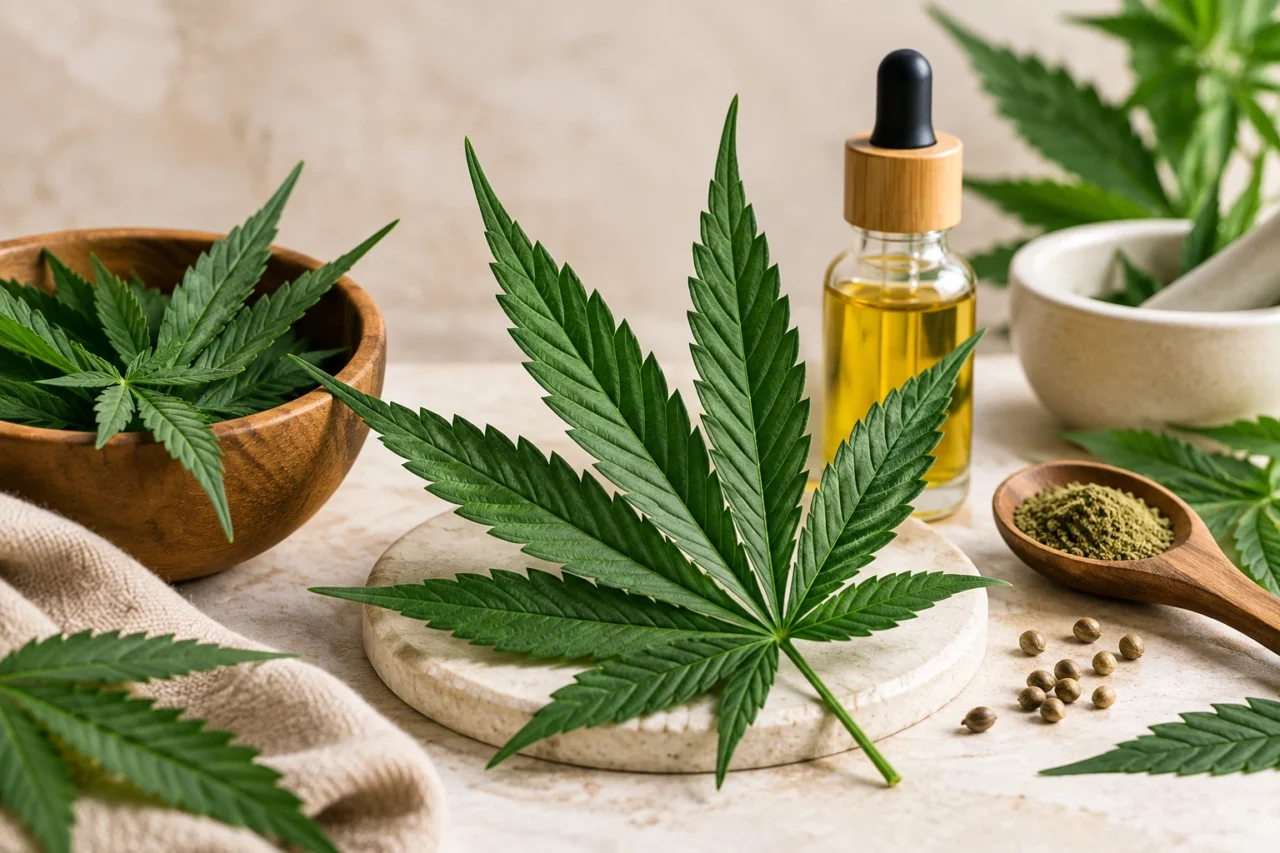
Quick Answer: Cannabis leaves contain cannabinoids, flavonoids, terpenes, and other plant compounds. Raw leaves may contain acidic cannabinoids such as THCA and CBDA, while heating can convert some acidic cannabinoids into their neutral forms, including THC and CBD. Research has found antioxidant activity and a range of phytochemicals in cannabis leaves, but there is still limited human evidence showing that eating cannabis leaves provides specific medical benefits.
Cannabis leaves can be used in foods, smoothies, juices, and other preparations. However, their cannabinoid content varies by plant and leaf type, so they should not be treated as a predictable medical treatment.
When people think about cannabis, they usually think about the flowers. The leaves often receive much less attention and may simply be discarded after trimming.
But cannabis leaves contain more than just green plant matter. Researchers have identified cannabinoids, flavonoids, terpenes, and other compounds in different parts of Cannabis sativa. Studies have also found that cannabinoids can be present in the trichomes located on the surface of cannabis leaves.
This has led to growing interest in questions such as: Can you eat cannabis leaves? Do cannabis leaves have health benefits? Do raw cannabis leaves get you high? And what is the difference between fan leaves and sugar leaves?
The answers are not as simple as some online articles suggest. Cannabis leaves do contain interesting compounds, but promising laboratory research does not automatically mean that eating the leaves produces a proven health benefit in humans.
This guide explains what cannabis leaves contain, their potential uses, how raw and heated leaves differ, and what the current research actually tells us.
Thinking About Using Medical Cannabis?
Considering cannabis for a health condition? Learn more about medical cannabis and discuss your options with a qualified healthcare professional.
What Are Cannabis Leaves?
Cannabis leaves are the green leaves that grow from the stems and branches of a cannabis plant. Their appearance, size, and chemical composition can vary depending on the plant’s genetics, growing conditions, maturity, and location of the leaf.
Not every leaf on a cannabis plant contains the same amount of cannabinoids.
Two terms you’ll often see are “fan leaves” and “sugar leaves.”
1. Fan Leaves
Fan leaves are the large leaves that extend from the plant’s branches and stems. They usually have several pointed sections and are one of the most recognizable parts of the cannabis plant.
Compared with flowers and sugar leaves, fan leaves generally have fewer cannabinoid-producing trichomes.
Research examining different cannabis plant parts has found substantially different cannabinoid concentrations between leaves and inflorescences.
Because fan leaves are relatively large and generally less concentrated in cannabinoids, people may use them for culinary preparations rather than treating them like cannabis flower.
2. Sugar Leaves
Sugar leaves are smaller leaves found around the cannabis flowers.
They often have visible trichomes, which are tiny glandular structures involved in producing and storing cannabinoids and other compounds.
A 2023 study using mass spectrometry imaging found cannabinoids associated with trichomes on cannabis leaves, including THCA and CBDA.
This helps explain why sugar leaves can have a different chemical profile from large fan leaves.
3. Fan Leaves vs. Sugar Leaves
| Feature | Fan Leaves | Sugar Leaves |
|---|---|---|
| Size | Larger | Smaller |
| Location | Stems and branches | Around flowers |
| Trichomes | Usually fewer | Usually more |
| Cannabinoid concentration | Generally lower | Generally higher |
| Common interest | Food and plant use | Cannabis processing |
The exact cannabinoid concentration can still vary significantly from one plant to another.
What Is in Cannabis Leaves?
One reason researchers continue studying cannabis leaves is their complex chemical profile. Cannabis leaves can contain several groups of naturally occurring compounds.
1. Cannabinoids
Cannabinoids are among the best-known compounds in cannabis.
Depending on the plant, researchers have identified compounds including:
- THCA
- THC
- CBDA
- CBD
- CBGA
- CBG
- CBC
- Other minor cannabinoids
A study examining different cannabis plant tissues found cannabinoids in leaves as well as flowers, although concentrations varied between plant parts and plant types.
2. THCA and CBDA
Fresh cannabis commonly contains acidic cannabinoids such as THCA (tetrahydrocannabinolic acid) and CBDA (cannabidiolic acid).
These are related to THC and CBD but are chemically different forms. THCA is the acidic precursor of THC. CBDA is the acidic precursor of CBD.
When exposed to heat, acidic cannabinoids can undergo decarboxylation, changing their chemical structure. This is one reason raw cannabis and heated cannabis can have very different effects.
3. Flavonoids
Cannabis also contains flavonoids, a large family of plant compounds found in many fruits, vegetables, herbs, and other plants.
Researchers have identified multiple flavonoids in cannabis leaves, including compounds such as flavones and flavonols. Some cannabis-leaf studies have also investigated relationships between flavonoid content and antioxidant activity.
4. Terpenes
Terpenes are aromatic plant compounds that contribute to the smell and flavor of many plants.
Cannabis contains numerous terpenes, and research has identified terpenoid compounds in different parts of the plant, including the leaves. The amount and combination of terpenes can differ depending on the plant variety and growing conditions.
Potential Health Benefits of Cannabis Leaves
The phrase “health benefits” needs some context.
Research has identified potentially useful biological activity in cannabis leaves, but that does not mean that eating the leaves has been proven to prevent or treat particular diseases.
Here are the main areas researchers are investigating:
1. Cannabis Leaves Contain Antioxidant Compounds
One study examining leaves from different Cannabis sativa varieties found antioxidant activity in leaf extracts and identified cannabinoids, flavonoids, and phenolic compounds among the plant’s constituents.
A later study analyzing 73 batches of cannabis leaves also identified numerous cannabinoids and flavonoids and examined their relationship with antioxidant activity.
These findings are scientifically interesting.
However, there is an important difference between antioxidant activity measured in a laboratory extract and a demonstrated health benefit from eating cannabis leaves.
2. They Contain Several Plant Compounds
Cannabis leaves are chemically more complex than many people realize.
Research has identified cannabinoids, terpenoids, flavonoids, sterols, and other secondary metabolites in cannabis plant tissues. This combination makes cannabis leaves an interesting subject for nutritional and pharmaceutical research.
It does not, however, mean that consuming the leaves automatically provides a therapeutic dose of any particular compound.
3. Acidic Cannabinoids Are Being Studied
THCA and CBDA are increasingly being studied separately from THC and CBD.
Research into acidic cannabinoids has explored their biological activity and potential therapeutic relevance. A recent review describes THCA, CBDA, CBGA, and CBCA as acidic precursors of their corresponding neutral cannabinoids and discusses their pharmacology and decarboxylation.
Some laboratory research has reported potentially interesting effects from acidic cannabinoids. But most importantly, research interest is not the same thing as proven clinical effectiveness.
Consumers should be cautious about articles that turn early laboratory findings into promises about treating specific health conditions.
Do Raw Cannabis Leaves Get You High?
Generally, raw cannabis leaves are much less intoxicating than heated, THC-rich cannabis.
One major reason is the difference between THCA and THC.
THCA is the acidic precursor of THC. Research has found that THCA itself does not produce the same psychoactive effects as THC in humans, while heat can promote its conversion into THC.
However, saying that raw cannabis leaves contain “no THC” would be too broad. Cannabinoid concentrations vary between plants and plant tissues, and measurable THC can occur in leaves.
So the better answer is:
Raw cannabis leaves generally have lower intoxicating potential than heated cannabis flower, but they are not necessarily completely free of THC.
What Happens When You Heat Cannabis Leaves?
Heating can change the chemical composition of cannabis.
The process is called decarboxylation.
For example:
THCA → THC
The same general process applies to acidic forms of other cannabinoids.
Research has examined how temperature, time, and other conditions affect the conversion of acidic cannabinoids into neutral cannabinoids.
This matters because someone consuming raw leaves is not necessarily consuming the same cannabinoid profile as someone smoking or heating cannabis.
Storage can also affect cannabinoid chemistry over time.
Can You Eat Cannabis Leaves?
Yes, cannabis leaves can be eaten, provided they are appropriately sourced, clean, and legally obtained.
Some people use fresh leaves in:
- Smoothies
- Juices
- Salads
- Sauces
- Green drinks
- Other food preparations
However, there is an important difference between using cannabis leaves as a food ingredient and using them as medicine.
Cannabinoid concentrations can vary substantially, so a homemade cannabis-leaf recipe does not provide a standardized cannabinoid dose.
1. Cannabis Leaf Smoothies
A smoothie is one way people incorporate fresh leaves into a food preparation.
Because cannabis leaves can have a strong, grassy flavor, they may be combined with ingredients such as:
- Banana
- Apple
- Cucumber
- Lemon
- Yogurt
- Plant-based milk
- Spinach
- Other fruits and vegetables
The amount of cannabis leaf used should not be presented as a medically established dose because there is no universally established serving size for treating a health condition.
2. Cannabis Leaf Juice
Fresh cannabis leaves can also be juiced.
Juicing avoids the combustion associated with smoking and does not involve the same heating conditions used to decarboxylate cannabis.
That means the chemical profile of the resulting drink can differ from that of heated cannabis. Again, the cannabinoid concentration will depend on the plant material.
Can You Make Cannabis Leaf Tea?
Cannabis leaf tea is another preparation people are curious about.
However, there is an important limitation: cannabinoids are not highly water-soluble.
This means simply placing cannabis leaves in hot water does not guarantee that a predictable amount of cannabinoids will enter the drink.
The final cannabinoid content can depend on:
- Leaf type
- Cannabinoid concentration
- Temperature
- Preparation time
- Other ingredients
- Whether the leaves were heated or processed beforehand
Therefore, cannabis leaf tea should not be treated as a standardized cannabis dose.
Can You Smoke Cannabis Leaves?
Cannabis leaves can be burned, but large fan leaves are generally not comparable to cannabis flowers.
Flowers typically contain much more cannabinoid-rich trichome material than large fan leaves. Smoking also exposes the lungs to combustion products.
If someone is interested in cannabis leaves because of their plant compounds, eating or using them in food does not involve combustion.
However, any cannabis preparation containing THC can have intoxicating effects depending on its cannabinoid content and how it is processed.
Are Cannabis Leaves Nutritious?
Cannabis leaves contain various plant compounds, but calling them a “superfood” would go beyond the available evidence.
Studies have identified cannabinoids, flavonoids, terpenoids, and other compounds in the leaves.
However, the nutritional composition can vary based on:
- Cannabis variety
- Growing conditions
- Plant maturity
- Soil
- Harvesting
- Storage
- Processing
There is also not enough evidence to suggest that cannabis leaves are nutritionally superior to established leafy vegetables.
It is more accurate to describe them as plant material containing a range of phytochemicals.
Are Cannabis Leaves Safe to Eat?
Safety depends partly on where the leaves came from.
Cannabis intended for smoking or other non-food purposes may not have been grown under food-production standards.
Potential concerns include:
- Pesticide residues
- Mold
- Microbial contamination
- Heavy metals
- Soil contamination
- Fertilizer residues
- Unknown chemical treatments
Washing can remove dirt and some surface contaminants, but it does not guarantee that all chemical residues have been removed.
For this reason, don’t assume that any cannabis plant is automatically safe to eat simply because it is a cannabis plant.
Can Cannabis Leaves Be Used on the Skin?
Cannabis compounds are being studied for topical applications, but this should not be confused with putting a raw cannabis leaf directly on the skin.
A standardized topical product and a homemade cannabis-leaf preparation are very different things.
Their:
- Chemical composition
- Concentration
- Absorption
- Stability
- Safety
can all differ.
There is currently not enough evidence to recommend raw cannabis leaves as a treatment for a specific skin condition.
Cannabis Leaves vs. Cannabis Flower
Cannabis leaves and flowers have different roles within the plant and generally different cannabinoid concentrations.
| Cannabis Leaves | Cannabis Flower |
|---|---|
| Usually lower cannabinoid concentration | Usually higher cannabinoid concentration |
| Larger surface area | Dense flowering material |
| May contain THCA and CBDA | Often rich in cannabinoid acids |
| Can contain trichomes | Highly concentrated trichome material |
| Often used as plant material | Commonly used for cannabis products |
| Chemical profile varies | Chemical profile varies |
A 2020 study found that cannabis inflorescences contained considerably higher cannabinoid concentrations than leaves in the chemovars examined.
That difference is one reason cannabis leaves should not simply be considered weaker versions of cannabis flower.
Cannabis Leaves vs. Hemp Leaves
Cannabis and hemp can refer to plants within the Cannabis genus, but legal definitions can differ depending on the jurisdiction.
Hemp leaves can also contain cannabinoids and other plant compounds. The important point is that the name of the plant alone does not tell you the exact cannabinoid profile.
If you’re growing, buying, transporting, or consuming cannabis or hemp, check the laws that apply where you live.
What Are the Best Ways to Use Cannabis Leaves?
There is no scientifically established “best” way to use cannabis leaves for health. The appropriate preparation depends on the intended purpose.
1. For food
Fresh leaves can be incorporated into smoothies, juices, salads, or other recipes.
2. For avoiding combustion
Food and beverage preparations do not involve smoking or burning plant material.
3. For preserving acidic cannabinoids
Avoiding substantial heat can reduce the conversion of acidic cannabinoids such as THCA into THC.
4. For predictable cannabinoid dosing
Fresh leaves are not ideal for precise dosing because their cannabinoid concentrations vary. A tested and standardized product is generally more predictable than an unknown quantity of fresh leaves.
What Research Is Still Missing?
This is an important part of the conversation because many articles about cannabis leaves focus heavily on potential benefits while overlooking the research gaps.
Scientists still need better human studies examining:
- How much THCA and CBDA are absorbed from raw cannabis leaves
- Whether eating cannabis leaves produces measurable health outcomes
- How cannabinoid concentrations differ between individual leaves
- How preparation affects cannabinoid content
- Long-term effects of regularly consuming cannabis leaves
- Possible medication interactions
- Appropriate serving sizes
- The effects of different cannabis varieties
Current research provides useful information about the chemistry of cannabis leaves, but it does not establish that eating them can treat a particular disease. The broader evidence base for cannabis and cannabinoids also contains important limitations and areas where additional research is needed.
Cannabis Leaves: What We Know vs. What We Don’t
| What research supports | What remains uncertain |
|---|---|
| Leaves contain cannabinoids | Exact health effects of eating leaves |
| Leaves contain flavonoids | Standard serving size |
| Leaves contain terpenoid compounds | Long-term effects of regular leaf consumption |
| Cannabinoids can occur in leaf trichomes | Absorption of cannabinoids from raw leaves |
| Cannabis leaves can show antioxidant activity in laboratory testing | Whether this produces meaningful health benefits in people |
| Heating can convert acidic cannabinoids | Exact cannabinoid conversion in every preparation |
This distinction is useful when evaluating online claims about cannabis leaves.
Important Safety Considerations
If you decide to consume cannabis leaves, consider the following:
1. Know the source
Avoid plant material when you don’t know how it was grown or what chemicals were used.
2. Don’t assume “natural” means risk-free
Cannabis contains pharmacologically active compounds, and cannabis products can have risks and drug interactions.
3. Be careful with THC
Even though raw leaves generally have lower intoxicating potential than heated flower, cannabinoid concentrations vary.
4. Don’t use cannabis leaves as a substitute for medical care
If you’re trying to manage pain, inflammation, anxiety, sleep problems, or another health condition, discuss evidence-based treatment options with a healthcare professional.
Frequently Asked Questions
1. What are the health benefits of cannabis leaves?
Cannabis leaves contain cannabinoids, flavonoids, terpenes, and other plant compounds. Research has demonstrated antioxidant activity in cannabis-leaf extracts, but there is not enough human evidence to confirm specific medical benefits from eating the leaves.
2. Can you eat raw cannabis leaves?
Yes. Raw cannabis leaves can be incorporated into foods and drinks. However, their cannabinoid content can vary, and they should not be considered a standardized medical treatment.
3. Do cannabis leaves get you high?
Raw cannabis leaves generally have much less intoxicating potential than heated, THC-rich cannabis. However, leaves can contain measurable THC as well as THCA, so they should not automatically be considered THC-free.
4. What is the difference between fan leaves and sugar leaves?
Fan leaves are larger leaves that grow along the plant’s stems and branches. Sugar leaves are smaller leaves around the flowers and often contain more trichomes and cannabinoids.
5. Can you smoke cannabis leaves?
Yes, cannabis leaves can be burned, but large fan leaves generally contain fewer cannabinoid-rich trichomes than flowers. Smoking also involves combustion, which creates inhaled smoke.
6. Can you make tea from cannabis leaves?
Yes, cannabis leaves can be used to make tea, but cannabinoids are poorly water-soluble. Therefore, the cannabinoid content of homemade cannabis leaf tea can be unpredictable.
7. Do cannabis leaves contain CBD?
They can. Cannabis leaves may contain CBDA and CBD, depending on the plant variety and other factors. The concentration isn’t consistent across all cannabis plants.
8. Do cannabis leaves contain THC?
They can contain THC, along with THCA and other cannabinoids. However, leaves generally contain less cannabinoid material than cannabis flowers, and concentrations vary by plant and tissue.
9. Are cannabis leaves good for inflammation?
Some cannabis compounds have demonstrated anti-inflammatory activity in laboratory and preclinical research. That does not establish that eating cannabis leaves treats inflammation in humans. More clinical research is needed.
10. Are cannabis leaves safe to eat?
They may be suitable as a food ingredient when appropriately sourced and prepared, but safety depends on factors such as contamination, pesticides, plant chemistry, and the individual’s health and medications. Cannabis should not be assumed to be risk-free simply because it is a plant.
Conclusion
Cannabis leaves are more chemically interesting than their reputation as leftover plant material might suggest. Research has identified cannabinoids, flavonoids, terpenes, and other compounds in cannabis leaves, while laboratory studies have also found antioxidant activity.
But there is an important line between potential and proven benefit.
Raw leaves may contain acidic cannabinoids such as THCA and CBDA. Heating can change these compounds through decarboxylation, which is one reason raw cannabis and heated cannabis can produce different effects.
If you want to use cannabis leaves as a food ingredient, focus on the quality and source of the plant material and avoid treating homemade preparations as precise medical doses.
Most importantly, don’t rely on cannabis leaves to treat a health condition without appropriate medical guidance. The science is developing, and more human research is needed to determine exactly what benefits, risks, and practical uses cannabis leaves may have.
Sources
- PubMed — Cannabis Leaves, Cannabinoids and Flavonoids
- PubMed — Antioxidant Activity of Cannabis Leaves
- PubMed — Cannabis Leaves and Antioxidant Properties, 2024 Study
- PubMed — THCA and Its Conversion to THC
- PubMed — Acidic Cannabinoid Decarboxylation
- PubMed — Cannabis Plant Parts and Their Secondary Metabolites
- PubMed — Health Effects and Evidence on Cannabis and Cannabinoids