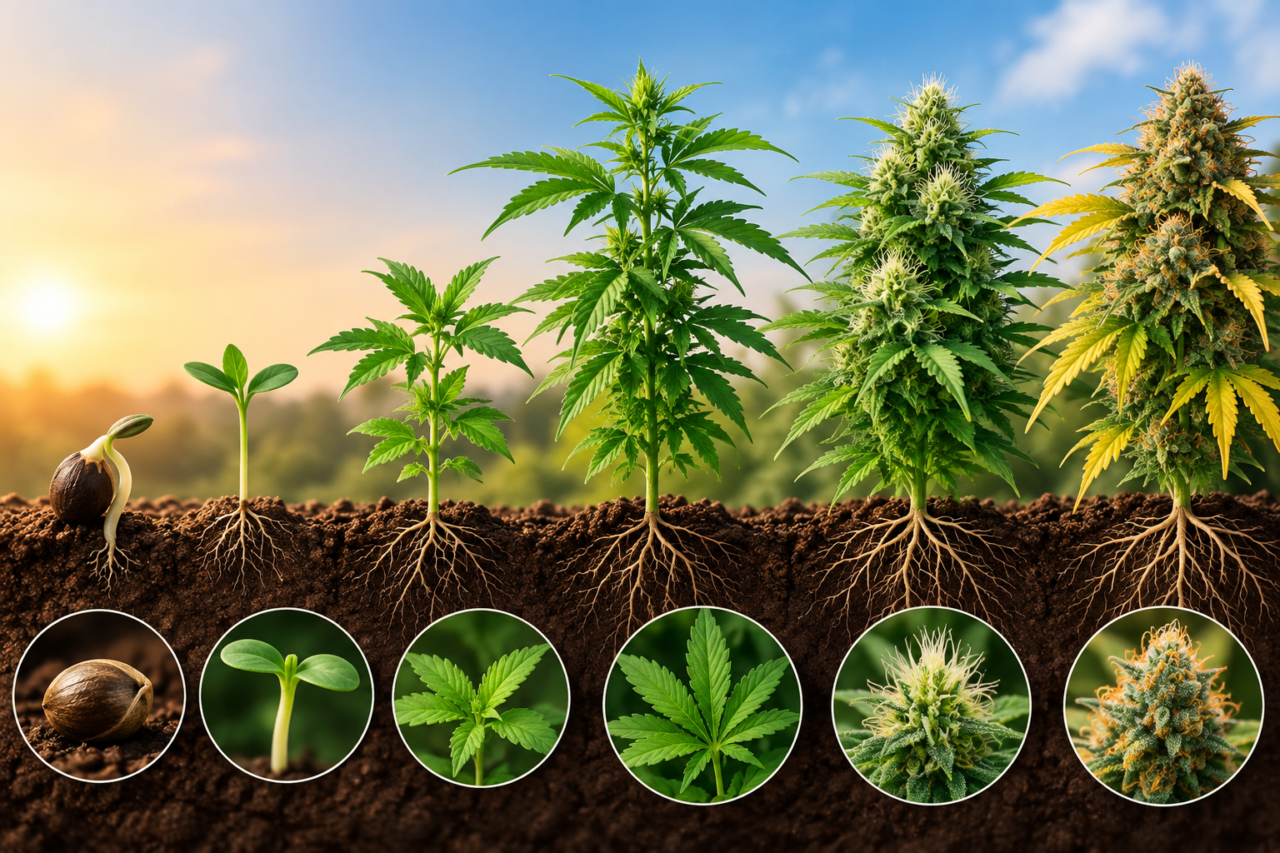
Quick Answer: Cannabis Plant Growth Stages describe the natural life cycle of a cannabis plant from seed to maturity. The main stages are germination, seedling, vegetative growth, pre-flowering, flowering, and harvest. During each stage, the plant changes in size, root development, leaf production, branching, flower formation, and resin production. The timing can vary depending on genetics, plant type, growing environment, and whether the plant is photoperiod or autoflowering.
A cannabis plant does not develop from a seed into a mature flowering plant overnight. It goes through several distinct stages, and each stage has a different purpose.
During the early stages, the plant focuses on establishing roots, producing leaves, and building a strong structure. As it matures, its growth changes and eventually shifts toward flower production. Understanding these changes can help you recognize what is happening to the plant at different points in its life cycle.
However, not every cannabis plant follows the exact same timeline. Genetics, environmental conditions, plant type, and other factors can affect how quickly a plant moves from one stage to another.
In this guide, we will explain the cannabis plant growth stages from germination through harvest, what happens during each stage, how to recognize the changes, and why the timeline can vary.
Get Professional Guidance Online
If you have questions about medical marijuana eligibility or need help understanding whether medical cannabis may be appropriate for your situation, you can speak with a licensed medical marijuana doctor.
Understanding the Cannabis Plant Growth Stages
The cannabis life cycle is generally divided into several stages:
- Germination
- Seedling
- Vegetative growth
- Pre-flowering or transition
- Flowering
- Maturity and harvest
Some sources combine certain stages, while others divide them into smaller phases. The exact terminology is less important than understanding what the plant is doing during each period.
The most important thing to remember is that these stages are developmental phases rather than fixed deadlines.
A plant that is six weeks old may look different from another six-week-old plant because genetics, environment, and plant type can affect its development.
1. Germination Stage
Germination is the first stage of the cannabis plant life cycle.
Before germination, the seed appears inactive. Once it receives suitable conditions, however, the biological processes inside the seed begin to activate.
The seed absorbs moisture, and the embryo starts developing. The first visible structure is usually the small root, known as the radicle.
What Happens During Germination?
Several important changes take place:
- The seed absorbs water.
- Internal biological activity increases.
- The seed coat begins to open.
- The first root emerges.
- The developing shoot begins moving upward.
- The young plant prepares to emerge.
The emerging root is an important sign that the seed has started developing.
How Long Does Germination Take?
Germination can occur within a few days, but the exact timing varies between seeds and growing conditions.
Some seeds may develop quickly, while others can take longer. Because of this variation, it is better to look for signs of development rather than rely on one exact number of days.
2. Seedling Stage
After the seed germinates and the young plant emerges, it enters the seedling stage. This is one of the easiest cannabis plant growth stages to identify because the plant is still very small.
The first leaves that appear are called cotyledons. These are different from the later leaves that develop as the plant matures.
Soon, the first true leaves begin appearing.
What Happens During the Seedling Stage?
The plant starts developing two major systems at the same time.
- Roots begin expanding: The young root system grows and starts supporting the developing plant.
- Leaves begin developing: True leaves appear and become increasingly complex as the plant grows.
The plant is also beginning to establish the basic structure it will need for later vegetative growth.
How Long Does the Seedling Stage Last?
The seedling stage commonly lasts for a few weeks, but there is no universal timeline. Growth can be faster or slower depending on genetics and environmental conditions. A healthy young plant should gradually show new growth rather than remaining unchanged.
3. Vegetative Growth Stage
The vegetative stage is when the cannabis plant begins focusing heavily on structural growth. This is often when you notice the biggest increase in plant size.
The plant develops:
- Larger leaves
- More leaves
- New branches
- Additional nodes
- A stronger stem
- A larger root system
- More growth sites
The plant is essentially building the structure that will support its later flowering.
What Happens During the Vegetative Stage?
The roots continue expanding beneath the growing medium while the above-ground portion of the plant becomes larger and more complex.
New leaves develop, branches become more noticeable, and the distance between different growth points can change as the plant matures.
The vegetative stage can last for very different lengths of time depending on the type of cannabis plant and its growing conditions.
What Is a Cannabis Node?
A node is a point along the stem where leaves and branches develop. Nodes are useful for understanding plant development because they show how the plant’s structure is becoming more complex.
A young plant may have only a few nodes, while a more developed vegetative plant can have many.
4. Pre-Flowering and the Transition Stage
Before full flowering begins, the plant goes through a transition period. This phase is often called pre-flowering or the transition stage.
During this period, the plant begins shifting away from primarily producing leaves and branches and toward reproductive development.
What Changes During Pre-Flowering?
You may notice changes around the plant’s nodes and the early development of reproductive structures. Another major change can be rapid vertical growth. This is commonly known as the flowering stretch.
The amount of stretch can vary considerably between different cannabis varieties. Some plants may increase significantly in height, while others remain relatively compact.
5. Flowering Stage
The flowering stage is one of the most important phases of the cannabis life cycle. During this stage, the plant focuses increasingly on reproductive growth.
Female cannabis plants begin developing flowers, which gradually become larger and more developed as flowering progresses.
What Happens During Early Flowering?
Early flowering can involve both continued structural growth and the beginning of flower development.
You may see:
- Early flower sites
- Visible pistils
- Continued vertical growth
- Developing flower clusters
- Changes around the nodes
The plant may still appear to be growing rapidly because of the flowering stretch.
What Happens During Mid-Flowering?
As flowering progresses, the developing flowers become more noticeable. Flower clusters gradually expand, and the plant begins putting more of its resources toward reproductive structures.
Trichomes also become increasingly visible as the flowers develop.
What Happens During Late Flowering?
Late flowering is the final part of the plant’s reproductive development.
Flowers become more mature, resin production becomes increasingly noticeable, and visible changes can occur in pistils and trichomes.
This is why the calendar alone is not always enough to determine plant maturity.
Cannabis Flowering Stages Explained
The flowering period itself can be divided into several general phases.
1. Early Flowering
The plant transitions from vegetative growth toward reproductive development. Flower sites become visible and the plant may continue stretching.
2. Mid Flowering
Flowers become larger and more developed. The plant’s growth becomes increasingly focused on flower production.
3. Late Flowering
The flowers continue maturing, and resin-producing trichomes become more prominent. The plant gradually approaches the end of its flowering cycle.
These phases are general descriptions rather than strict weekly deadlines.
What Are Trichomes?
Trichomes are tiny structures found mainly on cannabis flowers and nearby plant surfaces. They are responsible for much of the plant’s resin and contain many of its cannabinoids and aromatic compounds.
As the plant progresses through flowering, trichomes become easier to see. Their development is one of the visual changes associated with flower maturation.
Cannabis Plant Growth Stages Week by Week
A week-by-week timeline can help explain the general progression, but it should not be treated as an exact schedule.
| Approximate period | General development |
|---|---|
| Week 1 | Germination and emergence |
| Weeks 2–3 | Seedling development |
| Weeks 3–8+ | Vegetative growth |
| Early flowering | Transition and stretch |
| Mid flowering | Flower development |
| Late flowering | Flower maturation |
| Final stage | Harvest and post-harvest processing |
The actual timeline can vary significantly.
For example, a photoperiod plant may remain in vegetative growth for a much longer period than an autoflowering plant.
Photoperiod vs Autoflower Cannabis Growth Stages
One of the most important differences in the cannabis life cycle is whether the plant is photoperiod or autoflowering.
1.Photoperiod Cannabis
Photoperiod plants respond strongly to changes in the light and dark cycle.
When the appropriate seasonal or controlled light conditions occur, the plant transitions from vegetative growth toward flowering.
This means the vegetative period can vary significantly.
2. Autoflower Cannabis
Autoflowering plants generally transition toward flowering according to age and genetics rather than requiring the same light-cycle change associated with typical photoperiod plants.
As a result, their overall life cycle is usually more compact.
Why Does This Matter?
It explains why two cannabis plants of the same age can look completely different.
One may still be developing its vegetative structure while another may already be producing flowers.
How to Tell Which Cannabis Growth Stage a Plant Is In
Instead of relying only on the plant’s age, look at its physical development.
1. Germination
Look for:
- An opening seed
- An emerging root
- A developing shoot
2. Seedling
Look for:
- Cotyledons
- Small true leaves
- A short developing stem
- Limited branching
3. Vegetative Growth
Look for:
- Increasing leaf production
- Larger leaves
- More nodes
- New branches
- Rapid structural development
4. Pre-Flowering
Look for:
- Early reproductive structures
- Changes around the nodes
- Continued vertical growth
- Beginning flower development
5. Flowering
Look for:
- Developing flowers
- Increasing pistils
- Visible trichomes
- Larger flower clusters
- Increasing maturity
These signs can provide a better indication of development than age alone.
How Long Does the Cannabis Plant Life Cycle Take?
There is no single timeline that applies to every cannabis plant.
The total time from seed to harvest can vary based on:
- Genetics
- Plant type
- Vegetative period
- Flowering time
- Growing environment
- Overall plant health
Autoflowering varieties generally complete their life cycle faster, while photoperiod plants can have much longer vegetative periods.
This is why saying that every cannabis plant takes exactly the same number of weeks would be inaccurate.
What Factors Affect Cannabis Plant Growth Stages?
Several factors can influence how quickly and successfully a cannabis plant moves through its life cycle.
1. Genetics
Genetics can affect plant size, flowering time, structure, stretch, and overall development. Two plants can receive similar conditions and still develop differently.
2. Light
Light provides the energy plants need for photosynthesis. For photoperiod cannabis, changes in light duration also play an important role in triggering flowering.
3. Temperature and Humidity
Environmental conditions can influence plant growth and overall health. Extreme conditions can slow development or contribute to stress.
4. Water
Water is essential throughout the plant’s life cycle. Both inadequate and excessive water can cause problems, particularly when the plant has a small or stressed root system.
5. Nutrition
Nutritional needs can change as the plant develops. The requirements of a young plant are not necessarily the same as those of a mature flowering plant.
6. Plant Health
Pests, diseases, environmental stress, and root problems can all affect normal development. This is another reason why growth should be judged by the plant’s overall condition rather than its age alone.
Common Questions About Cannabis Plant Growth Stages
What are the main Cannabis Plant Growth Stages?
The main stages are germination, seedling, vegetative growth, pre-flowering, flowering, and harvest.
How long does each cannabis growth stage last?
There is no fixed timeline. Germination can take several days, the seedling stage may last a few weeks, and vegetative and flowering periods can vary considerably depending on genetics and plant type.
What happens during the vegetative stage?
The plant primarily develops its roots, leaves, stem, branches, and overall structure during vegetative growth.
When does cannabis start flowering?
Photoperiod plants generally begin flowering after receiving the appropriate change in their light cycle, while autoflowering plants typically transition according to age and genetics.
What is the flowering stretch?
The flowering stretch is a period of rapid vertical growth that can occur as the plant transitions from vegetative growth into flowering.
How can you tell when a cannabis plant is flowering?
Early flowers and reproductive structures begin appearing around the plant’s nodes. As flowering progresses, flower clusters become larger and more developed.
Do all cannabis plants grow at the same rate?
No. Genetics, plant type, environmental conditions, light, water, nutrition, and overall health can all affect growth speed.
Is a week-by-week cannabis growth timeline exact?
No. A week-by-week timeline is only a general reference. Physical development is usually more useful than age alone when identifying a plant’s stage.
Final Thoughts
Understanding the Cannabis Plant Growth Stages makes it easier to see how a plant changes from a seed into a mature flowering plant.
The journey begins with germination and continues through the seedling and vegetative stages. The plant then transitions toward flowering, develops its flowers, and eventually reaches maturity and harvest.
The most important point is that cannabis growth does not follow one universal schedule. Genetics, plant type, environment, and other factors can all change the pace of development.
Instead of focusing only on the number of days or weeks, pay attention to the plant’s actual signs of development. Changes in leaves, nodes, branches, flower sites, pistils, and trichomes can provide a much clearer picture of where the plant is in its life cycle.