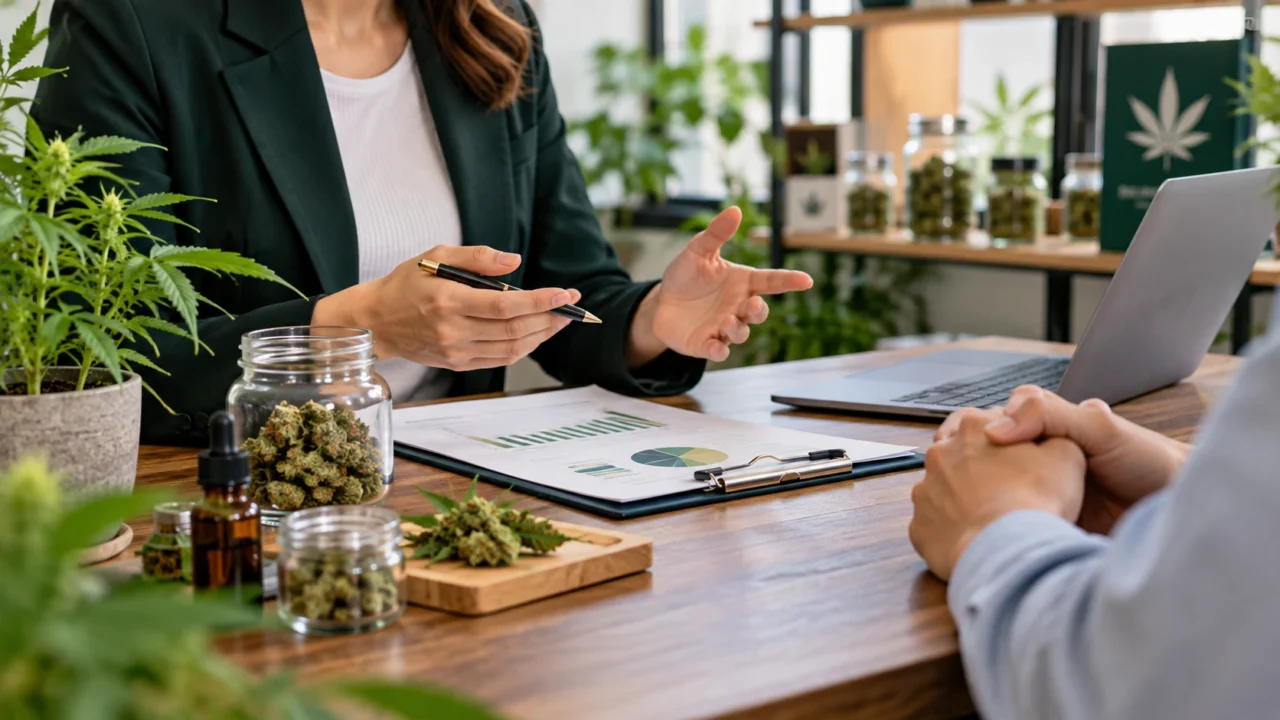
Quick Answer: A cannabis consultant is a professional who provides specialized guidance to cannabis businesses, growers, dispensary owners, entrepreneurs, and sometimes consumers. Depending on their area of expertise, they may help with cannabis cultivation, business planning, licensing preparation, regulatory compliance, dispensary operations, product development, marketing, staff training, or cannabis education.
Some consultants focus on one specialty, while others offer broader business support. If you are considering hiring one, look for relevant experience and services that match your specific needs. For legal, medical, or financial matters, it is still important to work with the appropriate licensed professional.
Someone opening a dispensary may understand retail but know little about cannabis regulations. A cultivator may understand plants but need help with business operations. An established cannabis company may have sales but struggle with inventory, compliance, staffing, or production efficiency.
This is where a cannabis consultant can be useful.
Rather than performing one standard job, cannabis consultants usually bring specialized knowledge to a specific problem. Their responsibilities can range from helping an entrepreneur develop a business plan to reviewing cultivation practices or creating standard operating procedures.
At the same time, the term “cannabis consultant” is broad. Not everyone using the title has the same education, experience, or legal authority. Understanding what these professionals actually do and what they cannot do, is important before paying for their services.
Need Help Understanding Cannabis Options?
If you have questions about cannabis products, medical cannabis, or how cannabis consultations work, getting guidance from a qualified professional can help you make informed decisions. A personalized consultation can give you a clearer understanding of your options based on your individual needs.
What Does a Cannabis Consultant Do?
A cannabis consultant helps clients solve specific problems using knowledge of the cannabis industry.
For a business, that might mean:
- Planning a new cannabis operation
- Reviewing business processes
- Developing standard operating procedures
- Improving cultivation methods
- Preparing for regulatory requirements
- Evaluating dispensary operations
- Developing products
- Improving inventory management
- Training employees
- Reviewing marketing strategies
- Identifying operational inefficiencies
The consultant’s role depends heavily on their specialty.
For example, an experienced cultivation consultant may know about lighting, irrigation, environmental controls, plant nutrition, pest management, harvesting, and post-harvest processes. A retail consultant may focus instead on customer experience, inventory, staffing, point-of-sale systems, and store procedures.
A business owner therefore shouldn’t simply search for “the best cannabis consultant.” It is more useful to find someone with experience that matches the specific problem.
Types of Cannabis Consultants
There is no single type of cannabis consultant. The industry has developed several specialties.
1. Cannabis Business Consultants
Business consultants help entrepreneurs plan, launch, or improve cannabis companies.
Their work may include:
- Business planning
- Market research
- Operational planning
- Financial modeling
- Budget development
- Business structure guidance
- Vendor evaluation
- Workflow design
- Expansion planning
For example, someone planning a dispensary might have funding and a general business idea but no experience operating a cannabis retailer. A consultant with retail and cannabis-industry experience could help identify operational requirements and potential problems before the business launches.
A consultant can provide expertise, but they should not promise guaranteed licensing approval, guaranteed profits, or guaranteed business success.
2. Cannabis Cultivation Consultants
Cultivation consultants focus on growing cannabis. This area was historically one of the most recognizable forms of cannabis consulting.
A cultivation specialist may evaluate:
- Lighting systems
- Irrigation
- Growing media
- Environmental controls
- Plant nutrition
- Pest management
- Harvest procedures
- Drying and curing
- Facility workflow
- Production consistency
For an existing cultivation facility, a consultant might review why yields are inconsistent and recommend changes to the production process.
However, recommendations should account for the laws and licensing requirements that apply to the specific facility.
3. Cannabis Compliance Consultants
Cannabis businesses operate in a heavily regulated environment. Compliance consultants help businesses understand and organize their regulatory obligations.
Depending on the jurisdiction and the consultant’s qualifications, services may include:
- Compliance audits
- Standard operating procedures
- Recordkeeping systems
- Employee compliance training
- Inventory procedures
- Packaging and labeling reviews
- Regulatory documentation
- Operational checklists
For example, a retailer may have good sales but poor documentation procedures. A compliance consultant could identify gaps and help create processes designed to reduce regulatory risk.
Cannabis rules are not identical across the United States. State programs can have different requirements for licensing, possession, retail sales, cultivation, transportation, testing, and other activities. The National Conference of State Legislatures maintains a state cannabis legislation database that tracks enacted cannabis policies.
4. Cannabis Dispensary Consultants
Opening a dispensary involves more than choosing products and putting them on shelves.
A dispensary consultant may help with:
- Store layout
- Customer flow
- Inventory procedures
- Staff training
- Product organization
- Point-of-sale workflows
- Purchasing procedures
- Customer service
- Daily operating procedures
Imagine a new dispensary experiencing long lines even though it has enough employees. A consultant might examine the customer journey, checkout process, product organization, and staff responsibilities to identify bottlenecks.
5. Cannabis Product Development Consultants
Some consultants specialize in developing cannabis products.
Depending on the client’s business and jurisdiction, this can involve:
- Product concepts
- Product positioning
- Manufacturing workflows
- Packaging considerations
- Ingredient evaluation
- Quality-control processes
- Product-market research
Businesses selling products that make medical or therapeutic claims need to pay particular attention to federal requirements. The FDA states that cannabis and cannabis-derived products remain subject to applicable federal food, drug, and cosmetic laws, and it has taken action against companies making unapproved therapeutic claims.
A consultant should therefore avoid presenting unsupported health claims as established facts.
6. Cannabis Marketing Consultants
Marketing consultants help cannabis companies communicate with customers while working within applicable advertising and platform restrictions.
Their work may include:
- Brand positioning
- Website strategy
- SEO
- Content planning
- Customer research
- Email marketing
- Social media strategy
- Educational content
A cannabis marketing consultant should understand that ordinary marketing practices may not always translate directly to cannabis because advertising, product claims, age restrictions, platform rules, and state regulations can create additional limitations.
7. Cannabis Patient or Consumer Consultants
This is a different category that can cause confusion.
Some professionals use terms such as cannabis coach, cannabis wellness consultant, or cannabis educator when working directly with consumers.
These services may focus on cannabis education, product terminology, cannabinoids, terpenes, consumption methods, and questions about navigating available products.
This is different from running a cannabis business.
It is also different from seeing a licensed healthcare professional. A cannabis coach who is not a licensed healthcare provider should not diagnose medical conditions or present coaching as a substitute for medical care.
What Services Does a Cannabis Consultant Provide?
The services vary considerably, but a consultant may provide one or more of the following.
1. Business Planning
A consultant can help turn a general idea into an operational plan.
This could include defining:
- Target customers
- Products or services
- Revenue streams
- Staffing requirements
- Operating costs
- Suppliers
- Business processes
- Growth plans
The goal is to give the business owner a clearer understanding of how the operation will work.
3. Regulatory and Compliance Guidance
Cannabis regulations can affect nearly every part of a licensed operation.
A consultant may help organize compliance procedures and identify areas that require attention. However, businesses should verify legal requirements with the appropriate state or local regulator and seek legal advice when necessary.
This distinction matters because a consultant’s recommendation does not automatically make an activity legal.
4. Cultivation Planning
For cultivation businesses, consultants may assess the growing environment and production workflow.
They may look at factors such as:
- Facility design
- Lighting
- Irrigation
- Environmental monitoring
- Plant spacing
- Harvest scheduling
- Drying and curing
- Production consistency
The objective is generally to create a repeatable system rather than rely on guesswork.
5. Staff Training
Employees need to understand their responsibilities before a cannabis business opens its doors.
Consultants may create training materials or help train staff on topics such as:
- Customer service
- Product knowledge
- Inventory handling
- Workplace procedures
- Compliance procedures
- Safety practices
The specific training required depends on the business and jurisdiction.
5. Operational Audits
An established company can also hire a consultant.
For example, suppose a dispensary has:
- Excess inventory
- Slow checkout times
- Frequent documentation errors
- Inconsistent staff procedures
A consultant can review the operation and identify potential improvements. This can be more useful than hiring someone only during the startup phase.
Do Cannabis Consultants Help With Licensing?
They may, but their exact role varies.
Some consultants specialize in helping applicants organize information, understand application requirements, prepare operational plans, or coordinate documentation.
However, licensing decisions are made by the relevant government authority—not by the consultant.
For example, California cannabis businesses must deal with state and local requirements, and businesses need to understand which activities require licensing and authorization. State and local rules can also change.
A consultant who says, “I guarantee you’ll receive a cannabis license,” should be treated cautiously. A more realistic promise is assistance with preparation and organization.
Tip: Ask exactly what the consultant handles, what remains your responsibility, and whether legal services are included or must be obtained separately.
How Much Does a Cannabis Consultant Cost?
There is no universal cannabis consultant price.
Fees can depend on:
- The consultant’s experience
- Type of project
- Geographic location
- Business size
- Project duration
- Specialty
- Number of services required
- Whether the consultant works hourly or on a project basis
A short consultation may be billed hourly, while a larger licensing, cultivation, or operational project may involve a fixed project fee or ongoing contract.
Before hiring someone, ask for a written breakdown of:
- Services included
- Services excluded
- Total estimated cost
- Payment schedule
- Expected timeline
- Deliverables
- Whether revisions are included
- Whether outside professionals are required
Avoid choosing a consultant based solely on the lowest price.
Do You Really Need a Cannabis Consultant?
Not every cannabis business needs one.
A consultant may be useful when you are entering an unfamiliar part of the industry, dealing with a complex operational problem, or preparing for a major business change.
You may benefit from consulting if:
- You are new to the cannabis industry
- You are opening a dispensary
- You are developing a cultivation operation
- You need help creating SOPs
- Your operation has compliance gaps
- Your team lacks specialized cannabis knowledge
- You are struggling with operational efficiency
- You are expanding into a new market
On the other hand, a consultant may not be necessary for every small decision.
For example, paying a business consultant to answer a basic question that your regulator or accountant can answer directly may not provide much value.
Cannabis Consultant vs. Cannabis Doctor vs. Cannabis Coach
These terms are sometimes confused, but they describe different roles.
| Professional | Primary Role |
|---|---|
| Cannabis business consultant | Helps cannabis businesses with operations, strategy, compliance, cultivation, retail, or other industry functions |
| Cannabis cultivation consultant | Focuses on growing and production systems |
| Cannabis compliance consultant | Helps organize compliance processes and regulatory requirements |
| Cannabis coach/educator | Provides cannabis education and consumer guidance |
| Licensed healthcare professional | Provides medical evaluation and healthcare advice within their professional scope |
| Cannabis attorney | Provides legal advice and representation |
A cannabis consultant should not automatically be treated as a doctor or lawyer.
If your question involves a medical condition, medication interaction, diagnosis, or treatment decision, speak with an appropriate healthcare professional. Cannabis use can have health effects, and the CDC notes that cannabis can affect memory, attention, coordination, decision-making, and reaction time, among other effects.
If the issue involves licensing, contracts, business structure, or regulatory disputes, an attorney may be more appropriate.
How to Choose a Cannabis Consultant
Finding someone with a cannabis-related title is easy. Finding the right specialist requires more research.
1. Check Their Specific Experience
Ask:
- What type of cannabis businesses have you worked with?
- How long have you worked in the industry?
- What states or jurisdictions do you understand?
- What projects have you completed?
- What specific services do you provide?
Someone experienced in cultivation may not be the right person to advise a retail business.
2. Ask for Clear Deliverables
A good consulting agreement should explain what you will actually receive.
For example:
“The consultant will review the facility’s cultivation workflow, identify operational gaps, and provide a written improvement plan.”
That is much clearer than:
“We will help your business succeed.”
Specific deliverables make it easier to evaluate whether the service is worth the cost.
3. Be Careful With Guaranteed Results
Be cautious if someone guarantees:
- A cannabis license
- A specific amount of profit
- Guaranteed yields
- Guaranteed medical outcomes
- Guaranteed regulatory approval
- Guaranteed business success
Cannabis regulations, markets, customer behavior, and business conditions can change.
A consultant can provide expertise, but they cannot control every external factor.
4. Verify Professional Qualifications
Look at the person’s background and determine whether their expertise matches your needs.
If the project involves legal work, verify that legal advice is coming from an appropriately licensed attorney. If it involves medical care, use an appropriately licensed healthcare professional.
What Should You Ask Before Hiring a Cannabis Consultant?
Before signing an agreement, ask these questions:
1. What is your area of specialization?
You want to know whether they focus on cultivation, retail, compliance, business strategy, marketing, product development, or another area.
2. What businesses have you worked with?
Relevant experience is often more useful than a generic cannabis credential.
3. What will you actually deliver?
Ask for specific reports, plans, SOPs, training, audits, or other deliverables.
4. What is included in the price?
Clarify whether meetings, revisions, travel, documentation, and follow-up support are included.
5. Do you provide legal or medical advice?
If they say yes, verify whether they have the professional license required to provide that advice.
6. How do you keep up with regulatory changes?
Cannabis rules change frequently. A consultant should have a process for staying current.
7. Can you provide references?
For a major project, references or examples of previous work can help you evaluate their experience.
Important Legal and Health Boundaries
Cannabis consulting sits at the intersection of business, regulation, and health, so boundaries matter.
1. Cannabis Laws Vary by Location
Cannabis may be permitted under a state’s medical or adult-use system while remaining subject to different federal rules. State requirements can also vary substantially.
The National Conference of State Legislatures maintains an updated database covering state cannabis legislation, including medical cannabis, adult-use cannabis, impaired driving, public health, and taxation.
Always check the rules that apply to the specific state and local jurisdiction involved.
2. Cannabis Consultants Are Not Automatically Medical Professionals
A person who understands cannabis products does not automatically have the qualifications to diagnose or treat a medical condition.
The FDA also warns that many cannabis and CBD products marketed with therapeutic claims have not been evaluated for those claims.
Consumers should therefore separate cannabis education from medical treatment.
3. Product Claims Need Careful Attention
Businesses sometimes use terms such as “natural treatment,” “pain cure,” or similar health claims in marketing.
Those statements can create regulatory problems when they are unsupported or made for products that have not been approved for those uses. The FDA has specifically taken action involving cannabis-derived products marketed with unapproved therapeutic claims.
Cannabis Consultant Example: How One Might Help a New Business
Imagine someone wants to open a licensed cannabis retail business.
They understand retail management but have never operated in cannabis.
Instead of trying to solve every problem alone, they might hire specialists for:
- Business planning: Develop an operating model and financial plan.
- Compliance: Review required procedures and documentation.
- Retail operations: Design customer flow and inventory processes.
- Staff training: Create employee procedures and product education.
- Marketing: Develop an SEO and content strategy that accounts for applicable restrictions.
- The consultant does not replace the government licensing authority, attorney, accountant, or healthcare professional. Instead, each professional handles the part of the project that falls within their expertise.
That distinction can save a business owner from expecting one consultant to solve every problem.
Cannabis Consulting for Consumers: Is It the Same Thing?
No.
Someone searching for “cannabis consultant” may actually be looking for help choosing or understanding cannabis products rather than starting a cannabis business.
Consumer-focused cannabis consultations may involve education about:
- THC and CBD
- Cannabinoids
- Terpenes
- Product types
- Consumption methods
- Product labels
- General cannabis questions
Some cannabis coaching services are designed specifically to provide individualized education. However, coaching should not replace medical care or diagnosis.
If you are considering cannabis for a health concern, discussing it with your doctor or another qualified healthcare professional is especially important.
Is a Cannabis Consultant Worth It?
The value depends on the problem you need solved.
A consultant can be useful when their expertise fills a genuine knowledge gap and their recommendations can improve your business processes, reduce avoidable mistakes, or help your team understand a specialized area.
The key is to hire for a specific need, rather than simply hiring someone because they call themselves a cannabis consultant.
Before paying for services, compare the consultant’s:
- Relevant experience
- Qualifications
- Specialization
- References
- Deliverables
- Pricing
- Contract terms
- Understanding of your jurisdiction
This approach makes it easier to determine whether consulting services are appropriate for your situation.
FAQs
1. What is a cannabis consultant?
A cannabis consultant is a professional who provides specialized advice related to cannabis businesses, cultivation, compliance, retail, marketing, product development, or cannabis education.
2. What services does a cannabis consultant provide?
Services can include business planning, cultivation guidance, compliance support, dispensary operations, staff training, product development, marketing, and operational consulting.
3. How much does a cannabis consultant cost?
There is no standard price. Fees depend on the consultant’s specialty, experience, location, project size, and whether they charge hourly, by project, or through an ongoing contract.
4. Can a cannabis consultant help me get a cannabis license?
A consultant may help organize an application or prepare business and operational materials, but licensing decisions are made by the relevant government authority. No consultant can legitimately guarantee approval.
5. What does a cannabis cultivation consultant do?
A cultivation consultant may evaluate growing systems such as lighting, irrigation, environmental controls, plant nutrition, harvesting, drying, curing, and production workflows.
6. Is a cannabis consultant the same as a cannabis doctor?
No. A cannabis consultant may provide business or cannabis education services, while a licensed healthcare professional provides medical evaluation and advice within their professional scope.
7. Do I need a cannabis consultant to start a cannabis business?
Not necessarily. However, consulting may be useful when you lack specialized industry experience or need help with areas such as operations, cultivation, compliance, or business planning.
8. How do I choose a cannabis consultant?
Look for relevant industry experience, a clearly defined specialty, transparent pricing, specific deliverables, references, and an understanding of the laws that apply to your location.
9. Can a cannabis consultant give medical advice?
Only if the person is appropriately licensed and acting within their professional scope. A general cannabis consultant should not be assumed to have the qualifications to diagnose or treat medical conditions.
10. Why are cannabis consultants becoming more specialized?
The cannabis industry includes cultivation, manufacturing, retail, technology, compliance, marketing, and healthcare-related services. As businesses become more specialized, consultants often focus on a particular area rather than trying to advise on every part of the industry.
Final Thoughts
A cannabis consultant can help businesses and consumers navigate specialized areas of the cannabis industry, but the role is much broader than simply advising people about growing marijuana.
Depending on their expertise, consultants may work in cultivation, retail, business strategy, compliance, product development, marketing, or cannabis education.
The most important step is matching the consultant to the problem you actually need to solve. A cultivation expert is not necessarily a compliance expert, and a cannabis coach is not automatically a medical professional.
Because cannabis regulations and scientific knowledge continue to evolve, use current government information and appropriately qualified professionals for legal and medical questions.